|
TheAtlasEngine
|

|
|
TheAtlasEngine
|
|
Something to consider for mesh loading. More...
#include <vk_renderer.hpp>
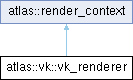
Public Member Functions | |
| vk_renderer (const window_settings &p_settings, uint32_t p_image_size, const std::string &p_tag) | |
 Public Member Functions inherited from atlas::render_context Public Member Functions inherited from atlas::render_context | |
| void | preload (const VkRenderPass &p_renderpass) |
| responsibility is to preload any data that is necessary to be loaded before being rendered | |
| void | begin_frame (const ::vk::command_buffer &p_current, const window_settings &p_settings, const VkRenderPass &p_renderpass, const VkFramebuffer &p_framebuffer, const glm::mat4 &p_proj_view) |
| indicator of when the start of the frame is | |
| void | end_frame () |
| Intended to use to indicate when to end recording to the GPU in the current frame. | |
| void | set_background_color (const std::array< float, 4 > &p_color) |
| sets the background color and request that change to the graphics API | |
| void | current_scene_context (ref< scene > p_scene) |
Something to consider for mesh loading.
How will meshes get loaded?
There are a few ways for considering for the base approach, which are: TODO: These are things to think about how this may happen because I want to make this lightweight in the sense the data isnt continuously being modified. Taking a looking at minimizing the loading state of vulkan implementation-specific meshes
Something to avoid is the entities containing the geometry data itself but being able to reference to their respective geometry data that are getting submitted to the GPU
|
overrideprivatevirtual |
Implements atlas::render_context.
|
overrideprivatevirtual |
Implements atlas::render_context.
|
overrideprivatevirtual |
Implements atlas::render_context.
|
overrideprivatevirtual |
Implements atlas::render_context.
|
overrideprivatevirtual |
Implements atlas::render_context.
 1.9.8
1.9.8